
Rising Property Taxes & Insurance in Michigan: The Hidden Costs Buyers Overlook When Qualifying for 2026 Loans
The hidden costs Michigan buyers overlook are property-tax uncapping (your taxable value resets to the state equalized value the year after you buy) and homeowners insurance premiums that have climbed with wind and hail claims. Together they can add hundreds of dollars to the monthly payment a generic calculator shows, which is why we qualify buyers on the real numbers instead of the sticker estimates.
Why do standard mortgage calculators fall short in Michigan?
Most online calculators focus on principal and interest and treat taxes and insurance as afterthoughts. In Michigan that assumption breaks: loan qualification in 2026 requires a real understanding of state-specific costs like fluctuating millage rates, wind and hail risk pricing, and updated flood zone designations.
At Priority Home Mortgage, our team helps buyers plan for these hidden costs. If you do not factor in local tax uncapping and rising insurance premiums, your actual monthly payment can inflate hundreds of dollars beyond a basic calculator’s estimate. We finance everyone from first-time homebuyers to seasoned investors, and our Purchase Assistant is built to structure your loan around reality, not base estimates.
What makes Michigan taxes and insurance different?
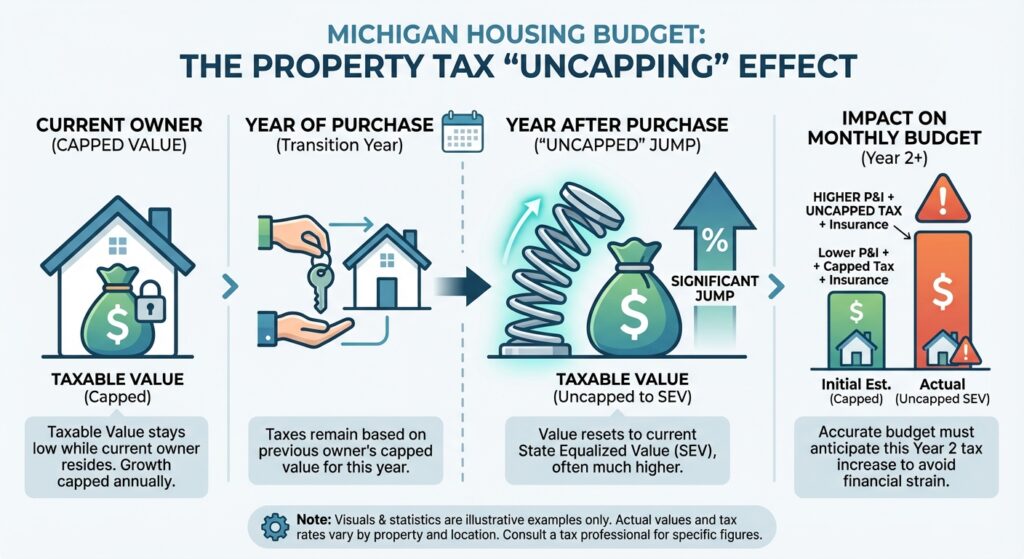
To budget accurately, you must account for the parts of a Michigan payment that generic tools miss:
- The uncapping of property taxes: Under Michigan law, a property’s taxable value is capped while the current owner lives there. The year after you purchase, the taxable value uncaps and adjusts to the current State Equalized Value (SEV). This can cause a significant jump in your tax bill that standard calculators miss completely.
- Local millage rates: Grand Rapids and surrounding West Michigan communities have specific millage rates funding schools, libraries, and emergency services, and they vary drastically even between neighboring zip codes.
- Weather-related insurance risk: Severe weather, including intense windstorms and hail, has driven up premiums across the state. Many policies now carry separate, higher deductibles for wind and hail damage, which raises your overall escrow requirement.
- Flood zone reclassifications: FEMA updates its flood maps as weather patterns shift. A home previously outside a high-risk zone may now require flood insurance, which directly affects your debt-to-income ratio on conventional loans and FHA loans.
Working with a local Grand Rapids lender means these factors get calculated properly before you make an offer, not discovered at closing.
| Cost component | Standard calculator estimate | True Michigan estimate |
|---|---|---|
| Principal & interest (P&I) | $1,800 | $1,800 |
| Property taxes (monthly) | $250 (based on old capped value) | $450 (based on uncapped SEV & local millage) |
| Homeowners insurance | $80 | $160 (includes wind/hail riders) |
| Flood insurance | $0 | $75 (if reclassified by FEMA) |
| Total monthly payment | $2,130 | $2,485 |
Hypothetical figures to illustrate how the gap opens. Your numbers depend on the specific property and policy.
How we protect your housing budget
Preparing for a purchase in 2026 means looking beyond the sticker price. Our team runs the actual numbers for the specific neighborhood you are targeting (exact millage rates, plus realistic premium estimates checked with local insurance agents), so the pre-approval you shop with reflects the payment you will actually make.
That comprehensive pre-approval is what prevents payment shock. Whether you are exploring VA loans, jumbo home loans, or a refinance to manage rising carrying costs on a home you already own, we will tailor the structure to your exact situation and keep the process simple, straightforward, and fast.
Frequently asked questions
Why do Michigan property taxes increase after buying a home?
Due to Michigan’s Proposal A, a property’s taxable value is capped for the current owner. Once the property is sold, the taxable value uncaps the following year to match the current assessed value, which often results in a significantly higher tax bill for the new buyer.
What is a millage rate and how does it affect my mortgage payment?
A millage rate is the tax rate used to calculate local property taxes. One mill equals one dollar per $1,000 of taxable property value. Higher millage rates in certain Grand Rapids neighborhoods increase your monthly escrow payment.
Why are home insurance rates rising in Michigan?
Insurers have been adjusting premiums to account for increased claims from severe weather events, specifically wind and hail storms. Higher replacement costs for building materials also contribute.
Will I need flood insurance if I buy a home in West Michigan?
It depends on the property’s location under the latest FEMA flood maps. If the home sits in a designated high-risk flood zone, your lender will require a separate flood insurance policy.
How can Priority Home Mortgage help me avoid payment shock?
We qualify you on uncapped taxes, accurate millage rates, and realistic insurance premiums, so your pre-approval reflects the true cost of the home before you sign anything.