
What Does It Cost to Flip a House in Michigan?
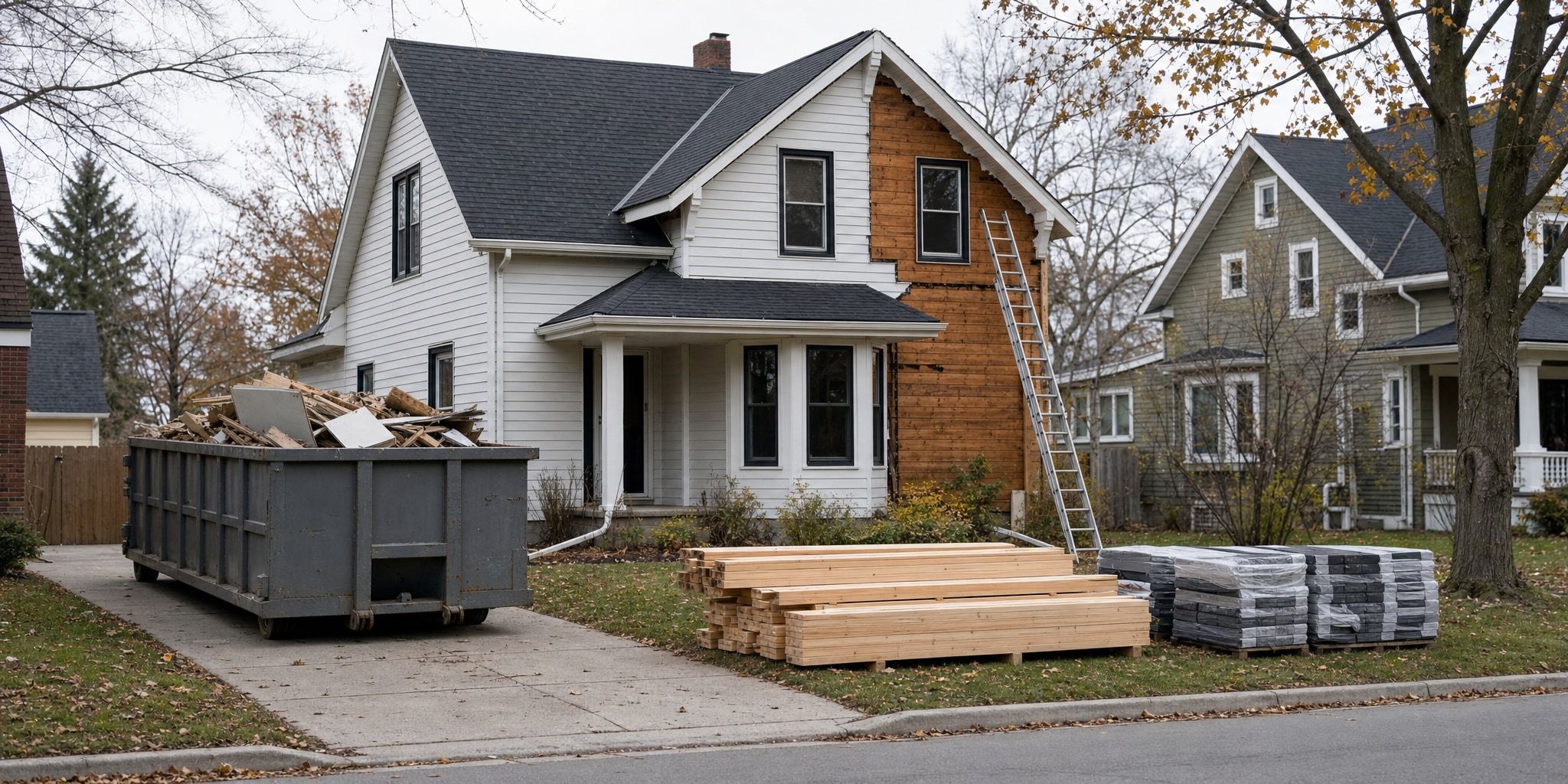
Flipping a house in Michigan costs the purchase price plus seven kinds of cost: buying, renovation, a set-aside for surprises, monthly holding, selling, Michigan’s transfer tax, and the loan. In the example below, a $150,000 house sold for $280,000 takes about $68,000 on top of its price, before the loan’s interest and fees. The seller pays the transfer tax, and on a flip the seller is you.
Tax rates and rules as of November 2026. We checked the tax and resale points here against State of Michigan and federal sources on November 22, 2026. Each one is linked.
Follow along with your own deal in our fix-and-flip calculator. It takes four numbers: what you buy the house for, what you put into it, what you sell it for, and how many months it takes. It also adds the cost of the loan, which this article leaves to the calculator so the figures there stay current.
What are the costs of flipping a house?
The costs of flipping a house are the purchase price plus seven groups: buying, renovation, surprises, holding, selling, Michigan’s transfer tax and the loan. First-time investors tend to plan for the renovation and forget most of the rest. The transfer tax has its own row in the table, because it is easy to miss and the selling figure does not include it.
| Cost group | What is in it | Planning figure |
|---|---|---|
| Buying costs | Title work, settlement and recording charges, inspections | About 1 percent of the price you pay for the house |
| Renovation | Labor, materials, permits, dumpsters | Your contractor’s written bid |
| Set-aside for surprises | What you find once the walls are open | 10 percent of the renovation, more on an older house |
| Holding costs | Property tax, insurance, utilities and upkeep | A monthly figure, for every month you own the house |
| Selling costs | Agent commissions and the seller’s closing costs, other than the transfer tax | About 6 percent of the sale price for both together |
| Michigan transfer tax | State and county tax on the sale | $8.60 for each $1,000 of the sale price |
| Loan costs | Interest, points (a fee paid up front, figured as a share of the loan amount), lender fees and the appraisal | See the calculator |
The planning figures are rules of thumb, not quotes. They are the same starting allowances our calculator uses, and you can change each one there to match your deal.
What do buying costs include?
Buying costs are the charges to close on the purchase: title work, the settlement charge, recording, and your inspections. As a planning figure, set aside about 1 percent of the price. In Michigan the seller customarily buys the owner’s title policy, which keeps the buyer’s side lighter.
Do not skip the inspection to save money. A general inspection and a sewer camera cost little next to a collapsed drain line you find after closing.
Buying costs are separate from the money the loan asks of you at closing. That part depends on the lender and on your experience. The calculator shows it as “Cash you need.”
How much should you budget for the renovation and for surprises?
Budget the contractor’s written bid, plus a set-aside of at least 10 percent of that bid for surprises. Raise the set-aside for an older house or one you could not fully inspect.
Ask for a bid that lists each job on its own line: roof, furnace, electrical, plumbing, kitchen, bathrooms, flooring, paint. Check that permits and dumpsters are in it. A single round number hides what the contractor left out.
Surprises are the rule in older Michigan houses. Old wiring, corroded pipes and a wet basement stay hidden until the walls and floors are open. The set-aside is there so one bad discovery does not sink the deal. If you never spend it, it becomes profit.
Many fix-and-flip loans pay the renovation in draws. The lender releases money after each stage of work is finished and inspected, so you or your contractor carry the cost until then. Plan your own money around that gap.
What are holding costs, month by month?
Holding costs are what the house costs for each month you own it: property tax, insurance, utilities and upkeep. The loan’s interest comes on top and is counted separately here. In our example they add up to $575 for each month you own the house, before interest.
| Holding cost | Monthly figure in the example |
|---|---|
| Property tax | $250 |
| Insurance on a vacant house under renovation | $75 |
| Utilities and upkeep | $250 |
| Total before interest | $575 |
The property tax and insurance figures are worked out from the price of the house. The calculator starts property tax at 2 percent of the price a year and insurance at 0.6 percent. On a $150,000 house that is $3,000 and $900 a year. Divide each by 12 to get the $250 and the $75 in the table. The tax can run higher on a house that is not your main home, especially after the sale resets its taxable value, so check the actual bill.
Property tax. Two Michigan rules can make your tax bill higher than the last owner’s. First, a flip is not your principal residence. Michigan’s principal residence exemption exempts an owner’s main home from the local school operating tax, and a flip does not get it.
Second, a sale lifts the cap on taxable value. Taxable value is the figure your tax bill is worked out from. Under MCL 211.27a, its yearly rise is limited to inflation or 5 percent, whichever is lower, but only until the house sells. For the calendar year after a sale, the taxable value resets to the property’s state equalized value, which is the assessed value without the cap. So plan for a higher bill if your project runs into the next year.
Insurance. A standard homeowner’s policy usually does not fit an empty house under construction. Ask an agent for a vacant-property or builder’s risk policy before you close.
Utilities and upkeep. The heat stays on through a Michigan winter, to protect the pipes and let paint and flooring set. Someone mows the lawn or clears the snow.
Interest. On most fix-and-flip loans you owe interest every month. That figure depends on the loan, so we leave it to the calculator.
What does it cost to sell, and who pays Michigan’s transfer tax?
Selling costs are the agent commissions and the seller’s closing costs. Michigan’s transfer tax comes on top of them, and the law puts it on the seller. On the day you bought the house, that was the person you bought it from. On the day you sell, it is you.
A purchase contract can shift who bears the tax. Bank-owned and auction sales sometimes do this, so read the addenda before you sign.
Michigan charges two transfer taxes on a sale:
- State: $3.75 for each $500 of the price, or fraction of $500, under MCL 207.525.
- County: $0.55 for each $500, or fraction of $500, under MCL 207.504. The statute lets a county of 2,000,000 people or more charge up to $0.75.
Together that is $4.30 for each $500, or $8.60 for each $1,000 of the sale price. Both acts put the tax on the seller: MCL 207.523 for the state tax and MCL 207.502 for the county tax. The Michigan Department of Treasury says it is paid through the county when the deed is recorded.
On a $280,000 sale there are 560 units of $500. The state tax is $2,100 and the county tax is $308, so the transfer tax is $2,408.
Agent commissions are negotiable, and no law sets them. As a planning figure, set aside about 6 percent of the sale price for commissions and your own closing costs together. The transfer tax is not in that 6 percent. A buyer may also ask you to pay part of their closing costs, which is called a seller concession.
What is the 70 percent rule, and where does it break?
The 70 percent rule says to pay no more than 70 percent of the after-repair value, minus the cost of the renovation. It is a rule of thumb that investors use to screen deals quickly. It is not a law.
After-repair value, or ARV, is what the house should sell for once the work is done. For our example house the rule works like this:
- Take 70 percent of the $280,000 ARV, which comes to $196,000.
- Subtract the $40,000 renovation, and the most to pay is $156,000.
- The house costs $150,000, so the deal passes with $6,000 to spare.
The other 30 percent, $84,000 here, has to pay every cost except the renovation and still leave your profit. That is the idea behind the rule, and it is also why the rule breaks in four places:
- Cheaper houses. At an ARV of $120,000, the 30 percent is only $36,000. A furnace, an inspection and a month of utilities cost about the same on a cheap house as on an expensive one. A deal can pass the rule and leave very little.
- Pricier houses. At an ARV of $600,000, the 30 percent is $180,000. The rule can reject a deal that would have paid well.
- Time. The rule has no months in it. The same house passes whether the project takes four months or ten, and those two deals do not earn the same.
- A wrong ARV. The rule is only as good as the sale price you feed it. Our guide on how to estimate ARV on a Michigan flip shows how to build that number from closed sales.
Use the 70 percent rule as a first screen. Then add up the real costs. The calculator shows the rule among its extra numbers, so you can see when the rule and the full math disagree.
How does time eat the profit on a flip?
Every extra month adds a month of holding costs and a month of interest, and it pushes your sale further out. In our example each extra month costs another $575, before interest.
Count the months from the day you close on the purchase to the day your buyer closes, not to the day the paint dries. The usual delays are permits, a contractor’s schedule, back-ordered materials and weather. Roofing, concrete and exterior paint all wait on a Michigan winter. After you accept an offer, a buyer with a mortgage still needs weeks to close.
Timing also decides which buyers can buy. A federal rule, 24 CFR 203.37a, restricts FHA-insured loans on houses that are resold soon after the seller bought them. Many first-time buyers use FHA loans, so a quick resale can shrink the pool of buyers for your house. A house cannot get an FHA-insured mortgage if the buyer signs the contract 90 days or less after you closed on your purchase. From day 91 through day 180, the buyer’s lender must get a second appraisal if your price is at least double what you paid. A fast flip may have to wait for day 91 before it can accept an offer from an FHA buyer.
What does a Michigan flip cost in a worked example?
In this example the house leaves $61,842 before loan costs. You buy it for $150,000, plan a $40,000 renovation, and sell it for $280,000 six months after you bought it.
The example uses the planning figures from the first table. Buying costs are 1 percent of the price, the set-aside is 10 percent of the renovation, and selling costs are 6 percent of the sale price.
| Item | Amount |
|---|---|
| Sale price | $280,000 |
| Purchase price | $150,000 |
| Buying costs | $1,500 |
| Renovation | $40,000 |
| Set-aside for surprises | $4,000 |
| Holding costs for the half year you own it | $3,450 |
| Selling costs | $16,800 |
| Michigan transfer tax | $2,408 |
| Total before loan costs | $218,158 |
| Left before loan costs | $61,842 |
The $61,842 is not your profit. The loan’s interest, points and fees still come out of it, and income tax is not in any of these numbers. Ask a tax professional how a flip is taxed in your case. To see what is left after the loan, type the same four numbers into the calculator.
Now let the plan slip. Say the house sells for $266,000. Say the sale also takes three months longer. The lower price costs $14,000, and three more months of holding costs add $1,725. The selling costs and the transfer tax fall a little with the price. The $61,842 drops to about $47,000, and three more months of interest come out of that. This is why the calculator tests every deal against a lower sale price, a higher renovation cost and a longer timeline.
What rules do first-time Michigan flippers overlook?
Two rules catch first-time flippers in Michigan: lead-safe work rules on houses built before 1978, and the seller’s disclosure statement when you resell. Neither is a row in the table, but both cost money and time if you learn about them late.
Lead-safe work on older houses. The EPA’s Renovation, Repair and Painting rule covers paid work that disturbs painted surfaces in homes built before 1978. Firms that do this work must be certified. A homeowner working on their own home is generally exempt, but the EPA says the rule does apply to someone who buys, renovates and sells homes for profit. So if you do any of the painting or demolition yourself on a flip, the rule covers you too. Ask each contractor for the firm’s lead-safe certificate before work starts, and check that the bid covers the lead-safe work.
The seller’s disclosure statement. When you resell, the disclosures that Michigan’s Seller Disclosure Act requires go on a set form. MCL 565.957 prints the form in full. Your answers are based on what you know when you sign, and the form asks when you lived in the house. On a flip the answer is often that you never did. The form says it is not a warranty, and it does not replace the buyer’s own inspection. Fill it out from what you learned during the renovation, and ask a real estate attorney if you are unsure how to answer.
What if the numbers do not work as a flip?
Walking away costs the least. You can also offer less and let the seller decide.
If you already own the house and the sale price comes in low, some investors keep it as a rental. A DSCR loan is one long-term loan built for that plan. DSCR stands for debt service coverage ratio. The loan qualifies on the rent the property brings in, not on your personal income.
If you plan to live in the fixer yourself, the loan is a different one. An FHA 203(k) loan puts the purchase and the repairs into one mortgage for a buyer who will live in the house.
Frequently asked questions
Who pays the transfer tax when you flip a house in Michigan?
The seller, by law. When you buy the house, the tax falls on the person you buy it from. When you sell it, it falls on you. A purchase contract can shift who bears it, so read yours. The state tax is $3.75 for each $500 of the price and the county tax is $0.55 for each $500.
How much money do you need to flip a house in Michigan?
It depends on the loan and the deal. You need the part of the purchase the loan does not cover, the buying costs, the lender’s fees, the holding costs, and enough to carry renovation work between draws. The calculator adds these up for your deal under “Cash you need.”
Do you have to follow the 70 percent rule?
No. The 70 percent rule is a screening rule that investors use, and nothing requires it. Use it for a first look, then add up the real costs of the deal.
Do you pay Michigan’s transfer tax when you buy the house?
Normally no. Both the state act and the county act put the tax on the seller, so the seller pays it at closing. A purchase contract can shift who bears it, which bank-owned and auction sales sometimes do, so read the addenda. Otherwise you pay it once, when you sell.
How long does a flip take?
It depends on the size of the renovation, the season and how fast the house sells. Count the months from your closing to your buyer’s closing, then test a longer timeline before you commit.
Ready to add up your own deal? Open the fix-and-flip calculator and enter your four numbers.
This article explains the costs of a flip in general. It is not legal or tax advice, and it is not an offer to lend. The example figures are illustrations, not a prediction for any deal. Priority Home Mortgage is an Equal Housing Lender.